
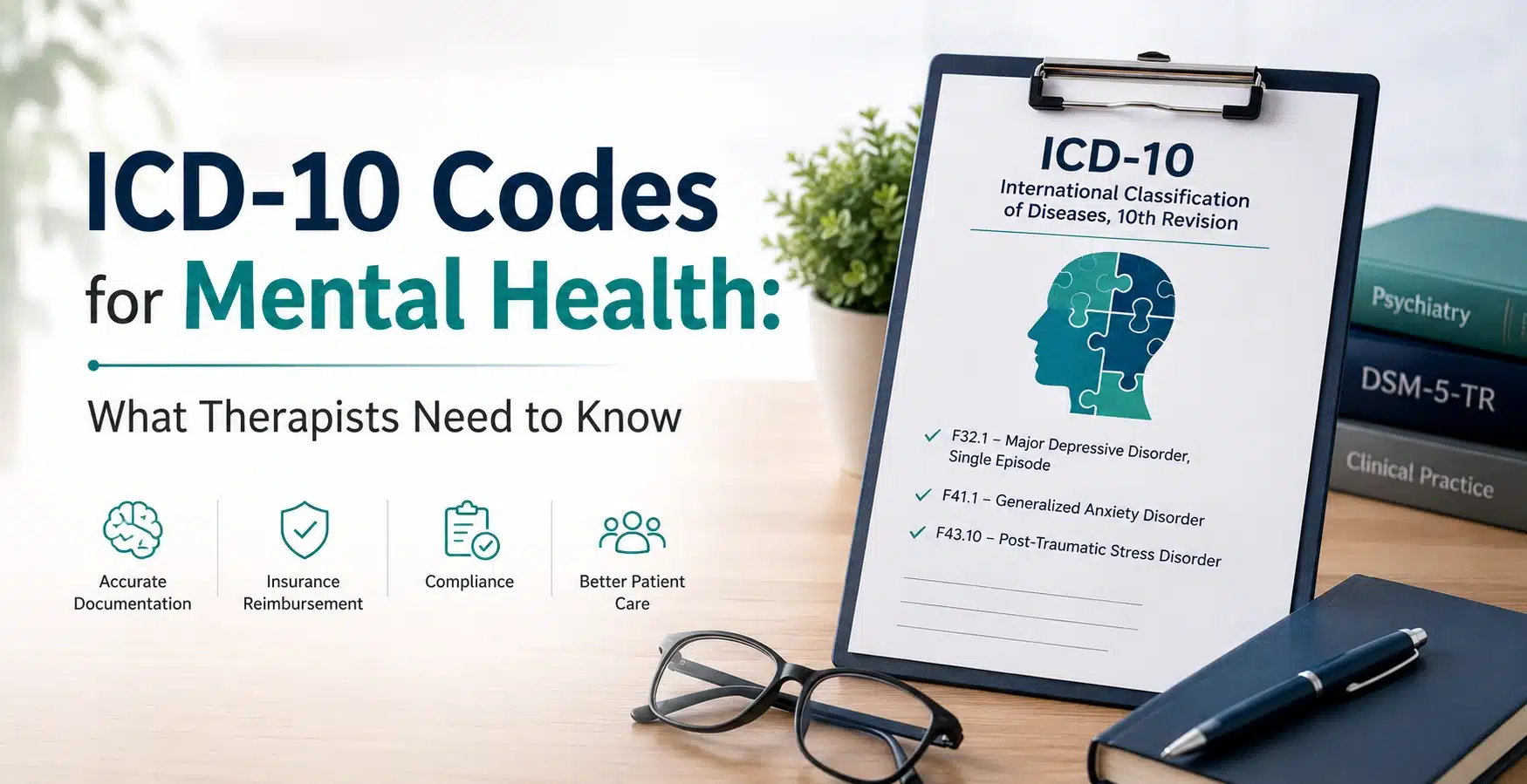
If you are a therapist working in the U.S., you already know the paperwork side of care is no joke. Between session notes, treatment plans and insurance submissions, there is a lot that has to go right – starting with getting your diagnosis codes right. ICD-10 codes for mental health are the backbone of clinical documentation and billing. Get them right and you get paid on time. Get them wrong and you are looking at claim denials, audits or worse.
This guide breaks down what these codes are, how they work, which ones you will use most often and what mistakes you need to stop making today.
Why ICD-10 Codes Matter for Therapists
These codes are not just paperwork formalities. They drive real outcomes in your practice – from your bottom line to how you document care.
Insurance Claims and Reimbursement
Every claim submitted to a payer must include a valid mental health diagnosis code. Insurers rely on these codes to assess medical necessity and determine reimbursement. If the code is inaccurate or too vague, it can lead to automatic denial, delayed payment and additional administrative work.
Transparent Clinical Documentation
Your clinical notes need to align with the codes you are billing. When they don’t, you have created a documentation gap that can come back to haunt you during a payer audit. Using the right code reflects the seriousness of your clinical thinking.
Treatment Planning
An accurate mental health diagnosis code helps structure the treatment plan. It connects the presenting symptoms to specific, evidence-based interventions. That alignment tells the story of why a patient needs continued care – which matters both clinically and from an insurance standpoint.
Compliance and Audit Readiness
HIPAA requires that providers maintain accurate medical records. When CMS or a private payer audits your claims, they will look at whether your codes match your notes. If your ICD-10 mental health codes do not reflect what is in the documentation, you could face recoupment of payments or compliance penalties.
ICD-10 vs DSM-5: What Therapists Should Understand
A lot of therapists get confused between these two systems. Here is the short version: DSM-5 is what you use to diagnose; ICD-10 is what you use to bill. They are related, but they are not the same thing. The table below shows the key differences:
Feature
DSM-5
ICD-10
Publisher
American Psychiatric Association (APA)
World Health Organization (WHO)
Primary Use
Clinical diagnosis and treatment guidance
Billing, insurance and health data reporting
Code Format
Descriptive diagnostic criteria
Alphanumeric codes (e.g., F32.1)
Required for Billing?
No – but informs the diagnosis
Yes – required on every insurance claim
Updated by
APA periodically
WHO; U.S. version managed by CMS and NCHS
Specificity
Broad diagnostic categories
Highly specific subcategories
Used in Therapy?
Yes – for assessment and planning
Yes – translated into billing codes
In practice, DSM-5 gives you the clinical framework and ICD-10 gives you the billing code. Both systems are updated periodically – so staying current with both is necessary.
One more thing worth knowing: the WHO adopted ICD-11 in 2022 and some countries are already transitioning. The U.S. has not yet adopted ICD-11 – ICD-10-CM remains the standard for all U.S. billing… A formal transition timeline has not been confirmed, but it is worth keeping an eye on as the field moves forward.
Common ICD-10 Code Categories for Mental Health
ICD-10-CM mental health codes range from F01 to F99. Below is an overview of each category, including what it covers and its relevance to everyday clinical practice.
F01-F09: Mental Disorders Due to Known Physiological Conditions
This section covers disorders linked to medical or neurological conditions, including vascular dementia, cognitive impairment related to HIV and personality changes due to traumatic brain injury… These diagnoses are frequently applied in older adults and medically complex cases.
F10-F19: Mental and Behavioral Disorders Due to Psychoactive Substance Use
This is the substance use disorder coding range. Each substance (alcohol, opioids, cannabis, stimulants, etc.) has its own subgroup with additional specificity for harmful use, dependence, withdrawal and induced disorders.
F20-F29: Schizophrenia, Delusional and Other Psychotic Disorders
This category includes schizophrenia, schizoaffective disorder, delusional disorder and brief psychotic episodes. These are among the most complex diagnoses clinically – and the codes require careful documentation of symptom duration and severity.
F30-F39: Mood Disorders
This category is widely applied in outpatient behavioral health care. It includes bipolar disorders, major depression, dysthymia and cyclothymia. Precise coding matters, as it differentiates conditions based on severity, episode type and remission status.
F40-F48: Anxiety, Stress-Related and Other Nonpsychotic Disorders
This is another high-frequency range for therapists. It includes generalized anxiety disorder, panic disorder, social anxiety disorder, PTSD, OCD and adjustment disorders. These are among the most common presenting issues in therapy practices across the U.S.
A note on OCD codes: The older F42.2 descriptor (“mixed obsessional thoughts and acts”) is no longer in active use under the current ICD-10-CM. The restructured OCD codes you will actually use include: F42.3 (Hoarding disorder), F42.4 (Excoriation/skin-picking disorder), F42.8 (Other obsessive-compulsive disorder) and F42.9 (OCD, unspecified). Always verify against the current CMS code set, which takes effect October 1 each year.
F50-F59: Behavioral Syndromes Associated With Physiological Disturbances
This range covers eating disorders, sleep disorders and sexual dysfunction. Anorexia nervosa, bulimia nervosa and binge-eating disorder all fall here. If you specialize in these areas, you will rely on this range frequently.
F60-F69: Disorders of Adult Personality and Behavior
This category includes personality disorder coding – borderline, antisocial, narcissistic and others. It also includes habit and impulse control disorders. Documentation here should reflect long-standing patterns, not situational behavior.
F70-F79: Intellectual Disabilities
Coded by severity level – mild, moderate, severe and profound – these codes are used in settings working with individuals with cognitive impairments. Documentation should include standardized assessment findings to support the coding level.
F80-F89: Developmental Disorders
This is where autism spectrum disorder (ASD) and communication disorders live. These codes require comprehensive developmental history and current functional assessments.
F90-F98: Behavioral and Emotional Disorders with Childhood Onset
This range covers ADHD, conduct disorder, separation anxiety and enuresis. If you are working with children and adolescents, this section will be a regular part of your coding work.
F99: Unspecified Mental Disorder
Technically classified as “Mental disorder, not otherwise specified,” F99 is your absolute last resort – use it only when no other code fits the documented clinical picture. Frequent use of F99 is a red flag to payers and meaningfully increases your audit risk.
Most Common ICD-10 Codes Therapists Use
These are the codes showing up on claims again and again in U.S. outpatient mental health practices:
ICD-10 Code
Diagnosis
Setting
F32.1
Major depressive disorder, single episode, moderate
Outpatient therapy
F33.1
Major depressive disorder, recurrent, moderate
Outpatient therapy
F41.1
Generalized anxiety disorder
Outpatient therapy
F41.0
Panic disorder
Private practice / community mental health
F43.10
PTSD, unspecified
Trauma-focused therapy
F43.11
PTSD, acute
Trauma-focused therapy
F43.12
PTSD, chronic
Trauma-focused therapy
F31.81
Bipolar II disorder
Outpatient / psychiatric settings
F90.0
ADHD, inattentive type
Child/adolescent therapy
F60.3
Borderline personality disorder
programs
F43.23
Adjustment disorder with mixed anxiety and depressed mood
General outpatient
F43.21
Adjustment disorder with depressed mood
General outpatient
F43.22
Adjustment disorder with anxiety
General outpatient
F10.20
Alcohol use disorder, moderate
Substance use programs
F42.9
Obsessive-compulsive disorder, unspecified
Outpatient therapy
A Closer Look: Adjustment Disorder Codes
Adjustment disorder is one of the most-billed diagnoses in outpatient therapy – yet it is easy to default to just one or two variants. Knowing the full breakdown helps you code with the precision payers actually expect:
Be precise here. Payers routinely flag repeated use of F43.20 (unspecified) across multiple sessions when a more specific subtype is clearly supportable from the documentation.
Z-Codes: Secondary Codes That Add Clinical Context
Here is something a lot of therapists overlook entirely: Z-codes. These are not standalone billable diagnoses – you cannot use a Z-code by itself to establish medical necessity – but when paired with a primary F-code, they add important psychosocial context that strengthens your documentation and supports ongoing care.
Common Z-codes used alongside mental health diagnoses:
Think of Z-codes as the “why behind the why.” They help explain the stressors driving or complicating the primary diagnosis. For long-term therapy cases especially, they can reinforce medical necessity when a payer questions ongoing treatment.
Coding Comorbidities: When a Patient Carries More Than One Diagnosis
Many therapy clients carry more than one diagnosis – depression and anxiety together, PTSD alongside a substance use disorder, ADHD with an adjustment disorder layered on top… The convention is straightforward: list the primary diagnosis driving the current encounter as the first code, then add secondary diagnoses after it.
This matters practically. Payers look at the primary code first when assessing medical necessity. If your patient’s main presenting issue is PTSD but you are listing an adjustment disorder first, that inconsistency can trigger a review. Lead with the diagnosis that best explains why this patient needs this level of care right now.
How to Choose the Right ICD-10 Code for a Mental Health Diagnosis
Picking the right code is not just about matching symptoms to a label. It is a clinical and administrative process that requires deliberate steps.
Start With the Clinical Assessment
Before you even open a code book, complete a thorough clinical assessment. Review the patient’s presenting symptoms, duration, functional impairment and history. Your diagnosis drives the code – not the other way around.
Match the Diagnosis to the Most Specific Code
Once you have established a diagnosis, find the most specific ICD-10 code that fits. Avoid using vague codes like F32.A (depression, unspecified) when you have enough clinical information to use F32.1 (moderate severity, single episode). Specificity reduces denial risk and demonstrates clinical rigor.
Heads up: F32.9 used to be widely referenced for unspecified depression, but it has been updated in recent ICD-10-CM releases. The current code for unspecified depression is F32.A. If that code is still showing up in your workflow, it is time to update. Always verify against the active CMS code set for the current fiscal year.
Document Medical Necessity
Every diagnosis you code must be supported by documentation. Your session notes should reflect medical necessity – why this patient needs this level of care, at this frequency, for this issue. If your notes don’t back up your code, the code is unsupported.
Check Payer Requirements
Different payers – Medicaid, Medicare, BlueCross BlueShield, Aetna, Cigna, etc. – may have their own coverage policies tied to specific codes. Before submitting, verify that the code is covered and that the service type aligns with payer guidelines.
Review Codes Regularly
ICD-10-CM is updated annually, typically taking effect every October 1st. Codes get added, revised and occasionally retired. Staying current is not optional – submitting a deleted code is an automatic denial. CMS publishes updates each spring, which gives you time to prepare before the new fiscal year kicks in.
ICD-10 Coding Mistakes Therapists Should Avoid
These are the errors that show up most often in mental health billing and they are all avoidable.
Using Unspecified Codes Too Often
Codes ending in “unspecified” or “NOS” (not otherwise specified) are red flags. Payers accept them when the clinical picture genuinely cannot be narrowed down further, but regular use signals incomplete documentation. Always use the most specific code the documentation supports.
Coding a Diagnosis Before It Is Clinically Supported
Some therapists assign a diagnosis after a single session because insurance requires one. That is a problem. Billing a diagnosis prematurely – especially for serious conditions like schizophrenia or PTSD – can create inaccurate clinical records and expose you to compliance risk.
Forgetting to Update Diagnoses
A patient’s diagnosis can change. If someone came in for an adjustment disorder and now clearly meets criteria for major depressive disorder, update the code in your records and claims. Billing an outdated diagnosis is inaccurate billing – and payers notice when the diagnosis never evolves across a year of treatment.
Using Outdated Codes
Every October 1st, CMS releases ICD-10-CM updates. Submitting a code that was retired or revised after that date results in a denial. Set a calendar reminder every fall to review the updated code set before your claims go out.
Mismatching Notes and Claims
This is one of the most audited issues in mental health billing. If your session note documents a different condition than what is on the claim, that is a serious red flag. Your documentation and your billing code must tell the same story – always.
Copy-Pasting Diagnoses Session After Session
Rolling over the same diagnosis note without reflection is a compliance problem. Each note should reflect the current clinical picture. If the presentation is stable and nothing has changed, say that specifically – but do not paste and forget. Payers notice when nothing in the documentation evolves across months of treatment.
What Payers Actually Look For in Audits
Payers do not audit randomly. They look for patterns that suggest incomplete documentation or inaccurate coding. Here is what commonly draws closer scrutiny:
Being aware of these patterns lets you document proactively – not defensively after a denial lands in your inbox.
How ICD-10 Codes Affect Mental Health Billing
Here is something that surprises many newer therapists: your mental health billing does not just depend on the service code (CPT code) – it also depends on the diagnosis code. Payers use ICD-10 codes to determine:
Under the Mental Health Parity and Addiction Equity Act (MHPAEA), insurers generally cannot impose more restrictive coverage requirements for mental health services than they do for comparable medical services. If you are receiving denials based on the diagnosis category and believe the decision is inconsistent with parity requirements, that is worth exploring further.
For telehealth sessions, the ICD-10 diagnosis code itself does not change – what changes is the CPT code modifier used to indicate the service was delivered remotely. The underlying diagnosis code stays the same regardless of delivery method.
For family therapy sessions billed under 90847 (family therapy with patient present), the identified patient’s diagnosis is what gets coded – not the family member’s. This trips up a lot of therapists, especially those newer to billing.
Beyond claim approvals, your ICD-10 codes affect reimbursement rates in value-based care arrangements and contribute to how mental health conditions are tracked nationally. If your practice works with multiple payers, partnering with a billing service that specializes in mental health – like Revix MD can significantly reduce errors and free you up to focus on the clinical work.
Best Practices for Therapists Using ICD-10 Codes
Keep Documentation Specific
Avoid vague language like “patient reports stress” or “mood issues.” Instead, document specific symptoms, duration, frequency and functional impact. Your notes are your defense in any audit – make them count.
Review Diagnoses During Treatment
Review whether the diagnosis still fits at least once during treatment – ideally every 90 days. This is especially important for patients in long-term therapy. If the patient has improved significantly or the clinical picture has shifted, update the diagnosis and document your rationale.
Use Updated Coding Resources
The CMS ICD-10-CM code set is available free at cms.gov. The CDC’s National Center for Health Statistics (NCHS) also maintains the official ICD-10-CM reference. The American Mental Health Counselors Association (AMHCA) and the American Psychological Association (APA) publish coding resources specifically for mental health professionals. Use them and always check the publication date when you do.
Work With a Qualified Biller or Coder
Coding is not always straightforward. Complex cases, comorbidities and payer-specific requirements can make choosing the right code genuinely difficult. Working with an experienced mental health billing partner means you have someone in your corner who understands the intersection of clinical care and billing compliance and can catch errors before they become denials.
Quick ICD-10 Mental Health Coding Checklist for Therapists
Before you submit any claim, run through this:
Final Thoughts
ICD-10 codes for mental health are not just administrative details – they are the foundation of your entire billing process. Getting them right means fewer denials, cleaner claims, better documentation and a practice that holds up to scrutiny.
The good news is, you do not have to figure it all out alone. Whether you need help building better documentation habits, understanding payer-specific requirements or simply submitting cleaner claims, working with a knowledgeable mental health billing partner can make a real difference.
Stay current, stay specific and let your documentation do the heavy lifting. Your patients and your cash flow – will thank you.
FAQs
Do therapists use DSM-5 or ICD-10 codes?
Therapists use DSM-5 to diagnose and ICD-10 to bill. The DSM-5 provides the diagnostic framework; the ICD-10 translates that diagnosis into the code required for insurance claims and clinical records.
What ICD-10 codes are used for anxiety?
Common anxiety codes include F41.1 (generalized anxiety disorder), F41.0 (panic disorder), F40.10 (social phobia, unspecified) and F40.11 (social phobia, generalized). That last distinction matters – generalized social phobia is broader in scope and specifying it when your documentation supports it adds important clinical precision. The right code always depends on the specific presentation and what your notes reflect.
What ICD-10 codes are used for depression?
Depression codes include F32.0-F32.9 for single episodes and F33.0–F33.9 for recurrent episodes. Severity specifiers (mild, moderate, severe) are captured in the fourth and fifth digits. Persistent depressive disorder (dysthymia) is coded as F34.1. Note that unspecified depression is now coded as F32.A – not F32.9, which has been updated in recent ICD-10-CM releases.
Can therapists bill without an ICD-10 code?
No. Every insurance claim must include at least one valid ICD-10 diagnosis code. Without it, the claim will be rejected. Self-pay clients don’t require a billed diagnosis, but most payers – including Medicare and Medicaid – require a code that supports medical necessity.
How often are ICD-10 codes updated?
The ICD-10-CM code set is updated annually on October 1st. CMS publishes the updates each spring, giving providers time to prepare. Always verify your codes against the current year’s code set before submitting claims.